


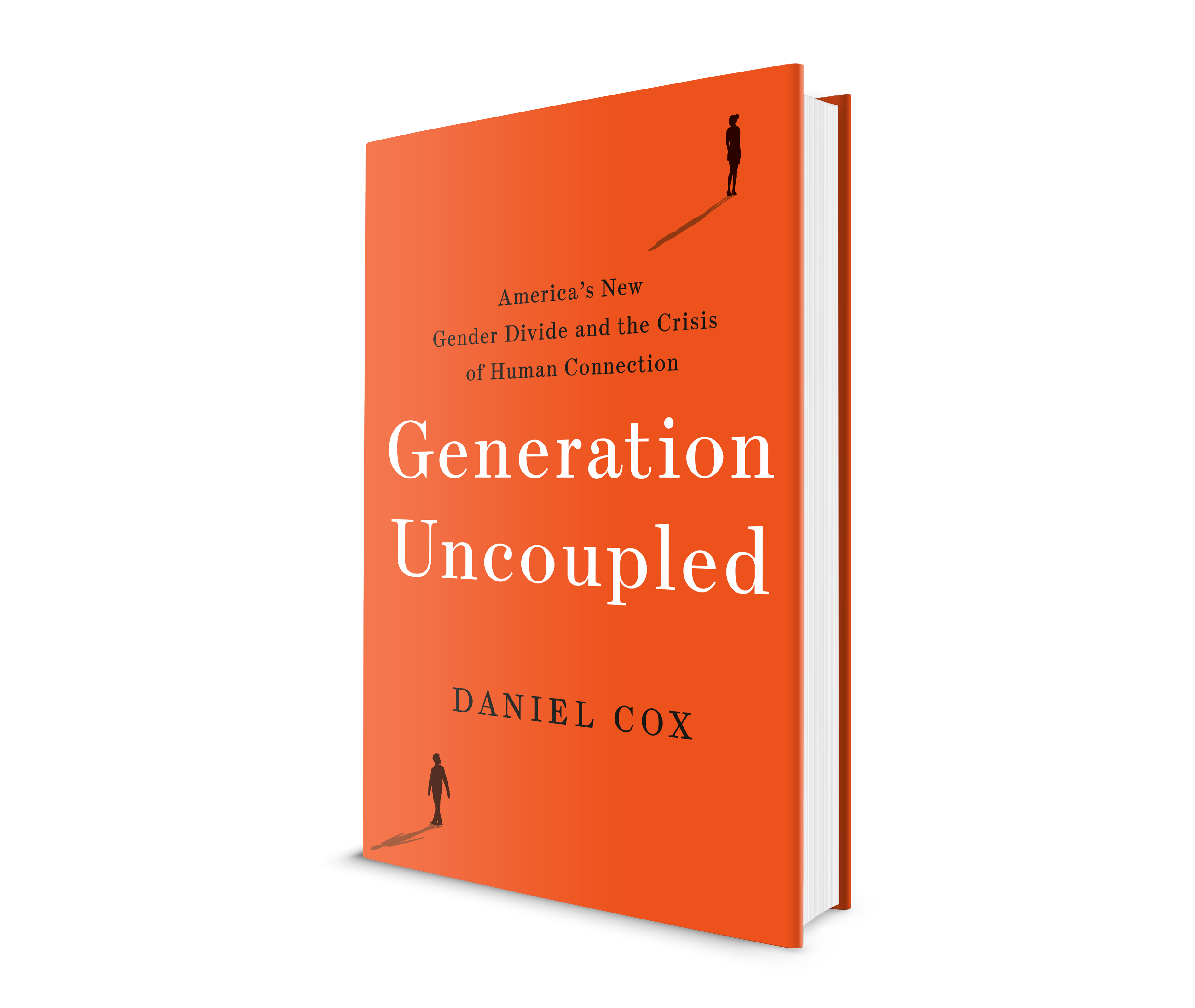
In both the very early days of a book project and in the very late stages, authors are encouraged to answer some version of the following question: Why should this book exist? It can be a difficult question to answer.
When my publicist for Generation Uncoupled prodded me to think about how I might answer this question, my first thought was: inertia. This book is the product of years of polling research and focus groups on a variety of topics, including dating, friendship and loneliness, changes in American family life, and trends in civic and associational belonging. The very first survey I conducted after arriving at AEI more than 7 years ago focused on dating and politics. In 2021, we conducted the first major study on the state of American friendship in decades and introduced the concept of the “friendship recession.” A year later, our polls started to reveal growing cultural and political divisions between young men and women. In many ways, the book was a culmination of these seemingly separate threads, and the process of writing it required weaving these strands together.
As the publication date creeps closer (Oct. 13!), I’ve also had a moment to reflect on my goals for the book. What do I hope it will accomplish? Here, I have a clearer idea. At least when it comes to the division between men and women, I hope the book serves as a pressure release value—a way to lower the temperature and reduce the volume in our public debates about dating, sex, and politics. At the risk of having immodest aspirations, I hope Generation Uncoupled changes the way we relate to one another. I hope it triggers greater introspection about how the time we spend online—whether it’s pornography, OnlyFans, or social media—warps our sense of reality and our sense of what we owe each other. Lastly, I hope to rekindle the curiosity that men and women once had about one another. I begin the book with a discussion of a research project that asked teen boys and girls about what it would feel like to live for a day as a member of the opposite sex. The answers were incredibly dispiriting. Here’s what I wrote:
“The most consistent response, from both boys and girls, was that the experience would be disorienting. The word “weird” came up more than a few times. Girls were more aware of the advantages afforded to them by switching genders, while boys’ reactions were more negative. Boys provided less detailed responses using significantly fewer words on average. And although the prompt specifically asked them to consider some aspect of the experience that would be exciting, not a single boy used that word in their response. Many girls did. But a depressing conclusion from this exercise was the demonstrable lack of genuine curiosity expressed by boys and girls alike about what it’s like to live as the opposite sex.”
Our brains endlessly encourage us to simplify—to reduce and make complicated things more accessible—but we should resist this impulse when it comes to our dealings with others. People are full of contradictions, guided by conflicting feelings and indiscernible motivations. I hope, after putting this book down, you are a bit more curious than before you picked it up.
I had another motivation in writing Generation Uncoupled. After years of documenting the ongoing decline of American social, civic, and religious activities, it seemed that there were few data-based arguments that explored America’s culture of obsessive self-regard. This is my attempt to push back on our culture of self-optimization and self-improvement that promotes personal recognition and individual achievement as the worthiest aspirations. We have become increasingly focused on ourselves, frequently at the expense of communal investments. We volunteer less, spend more time alone, and demonstrate less interest in participating in social, civic, and religious institutions. Instead, we focus on personal betterment as an end goal—gym memberships and therapy sessions are up, and the market for self-help books has experienced a massive uptick in the previous decade. I’m not attempting to argue against these pursuits—they are all laudable. You can make a great living now as a private tutor or personal trainer! We’ve convinced ourselves that self-optimizing is the secret to a good and meaningful life. It is not.
Even as the internet and social media have opened up new possibilities for connection, more of us are turning inward. We’re protecting our peace and practicing self-care. Online, we promote our distinctive lifestyles, interests, and perspectives. It comes at a cost.
“The practice of regular self-expression on social media became more fully integrated into adolescent experience, young people have taken these early lessons and dutifully applied them through every stage of life. Young adults are trained to see individualism as the highest societal value. They have been taught to mistrust public institutions, taught that they have to compete in a sink-or-swim economic system, and taught to participate in an all-or-nothing political process. It leaves them without the proper tools or even a serviceable vocabulary to express a commitment to something larger than themselves. America’s embrace of hyper-individualism has had disastrous consequences for communal life.”
As fiercely independent-minded as we might be, our actions and behavior are still strongly influenced by the people around us. Amidst growing polarization on the issue of the Covid-19 vaccine, there was one aspect that cut across political lines—whether your friends and family received it. If most of your social circle was vaccinated, chances are you were too, regardless of your educational background, where you lived, or who you voted for.
I never set out to referee disagreements between men and women, but I want to challenge a culture that denigrates communal commitments, rewards self-interest, and fosters distrust in our shared institutions. I believe that doing so leaves us more emotionally impoverished and less connected.
What the book ultimately reveals is that we don’t need a single right person to build a meaningful life—we need many people.
Book Reminders: Don’t Forget!
There is still time to submit your entry at Goodreads to win a free copy of Generation Uncoupled!
If you live in Washington D.C., consider coming out to one of the book events. On Oct. 14, the American Enterprise Institute is hosting a discussion and audience Q&A about the book, with free copies available. On Oct. 29, I’ll be at Politics & Prose—my favorite bookstore in the DMV. I’ll post additional public events as soon as they are finalized. I’ve been busy recording podcasts and talking with journalists, but I hope to have more public discussions to share soon. I’ll be visiting a number of college campuses around the country in the coming weeks.