

Generation Uncoupled Updates:
I’ll be at Politics & Prose bookstore tonight at 7pm for a conversation about Generation Uncoupled. Stop by if you’re in the DMV!
If you haven’t caught my interview with Chris Williamson on Modern Wisdom, you can watch the full interview here. It was an entertaining conversation!
I also had a great conversation with Jason Parham at WIRED about the dating app landscape and how the rush for expediency has degraded the entire experience of finding a partner.

One of the tragedies of the 21st century is how central the internet has become in our lives. For many of us, it’s the first thing we check in the morning and the last thing we see before falling asleep. It has become our constant companion, a powerful distraction, and a source of endless entertainment. And now, the internet increasingly serves as a place where people go to find community. A new study by Pew found that nearly half of young adults belong to an online community. And unlike older Americans, their purpose for frequenting these digital spaces is not simply to acquire information or get advice, but “to feel accepted.” Two-thirds of young adults who are part of an online community say that this is an important reason they spend time online, a rate far higher than that of older Americans.
I find this deeply troubling. I worry that social media and various chat forums can seem to fill a need while only offering a pale approximation of in-person places. Most young people do not see it this way. The same Pew study found that most young adults said online communities allow people to form just as meaningful personal connections as in-person communities. But social trust is built most effectively when developed through regular participation in organizations, clubs, and institutions in the real world—places with established norms and expectations for behavior. The internet is a low-trust environment. It is too easy to deceive, to manipulate, and to mask our intentions online (not to mention our identity). This is why the most common places Americans develop close friendships are schools, the workplace, places of worship, and their neighborhoods—not Reddit.
I’ve watched with some dismay as the horrific events at a Cornell University fraternity have morphed into a broader indictment of male-only social spaces. In a recent New York Times opinion piece, a philosophy professor at Cornell offered a stunning assessment of male association: “According to the norms within many all-male groups, when one man proposes doing something immoral or illegal, the bro code dictates that other men go along with it.” She cites no study to support this sweeping claim; rather, it is simply her personal belief about the inherent toxicity of male-only spaces.
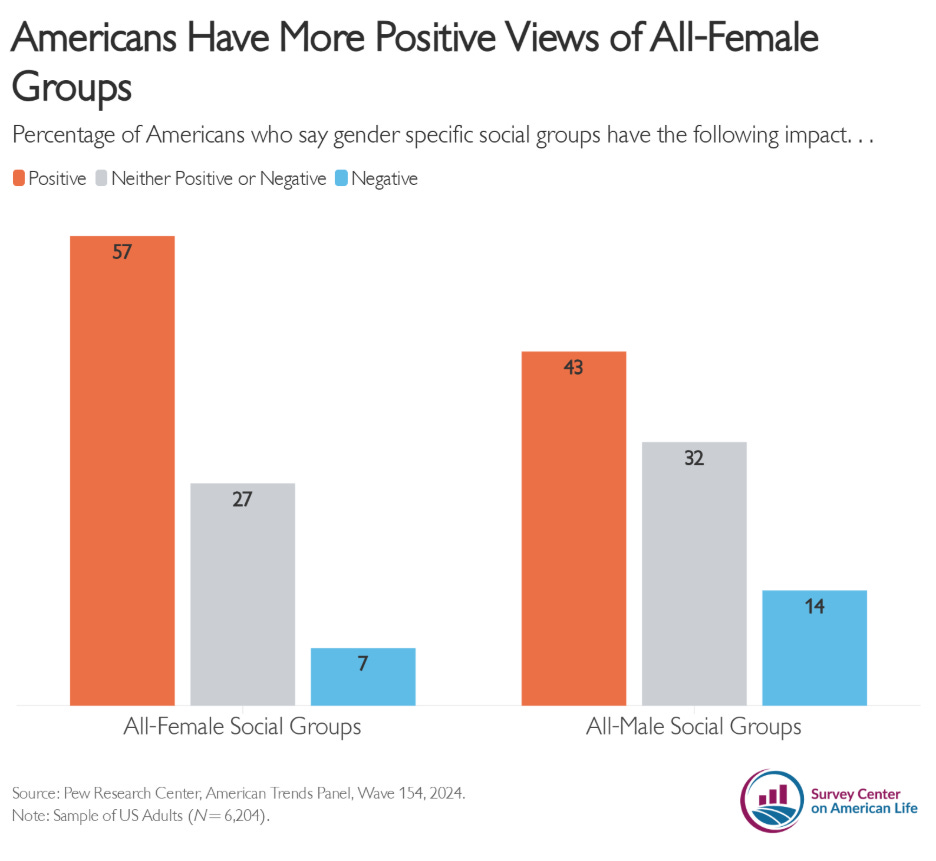
Public skepticism about male-only social spaces is hardly new. A recent Pew study found that while 57 percent of Americans said all-female social groups have a positive impact on society, only 43 percent said the same for male-only groups. These concerns have coincided with the disappearance of these spaces from society.
In Generation Uncoupled, I write:
“In many neighborhoods, barbershops struggled to fend off competition from national chains that offered cheaper or more convenient services. Veterans’ organizations and union halls started disappearing when they started running out of members. Even before the Boy Scouts became coed, their membership had plummeted. Vanishing male spaces represented a real loss, but it became exceeding difficult to articulate what their absence meant for boys and young men. Rising attention to enduring sexual abuse scandals, patterns of misconduct of male leaders, and the new language of male privilege stymied efforts to engage in more nuanced discussions. At a time when many young men felt the world had become less sympathetic to their problems and more focused on the negative consequences of their behavior, there were fewer spaces where they felt welcome.”
If these spaces disappear, the internet will fill the void. It already has, and the consequences have not been promising. A study by Common Sense Media of boys ages eleven to seventeen found that nearly seven in ten reported encountering posts that promote negative gender stereotypes, such as: Women are only interested in tall, wealthy, and attractive men. Sociologist Jean Twenge found that it was boys who use social media most heavily that have the most traditional views of gender roles.
At every turn, there are signs of accelerating social withdrawal. A newly released study shows that between 2010 and 2023, the amount of time boys spend outside has been cut in half. This is tragic and utterly foreseeable.
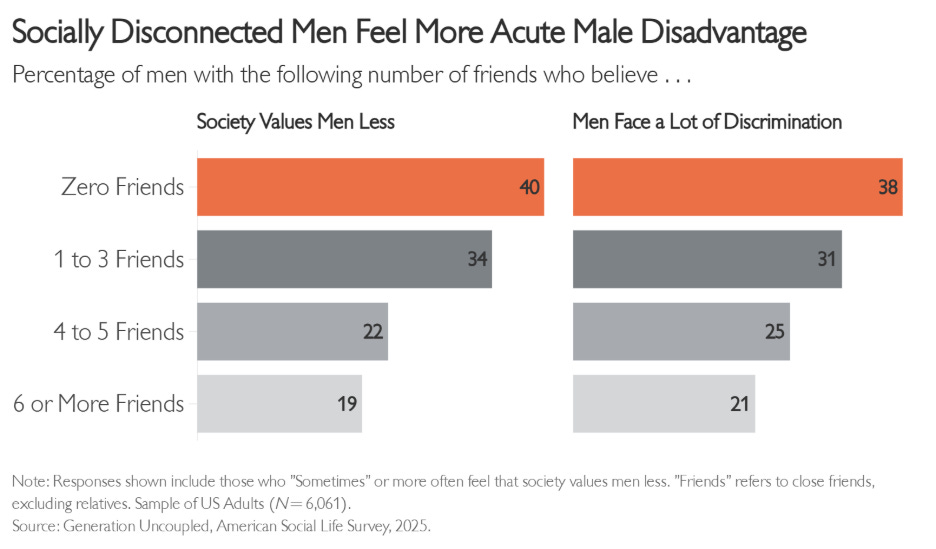
It is the lack of strong friendships that leaves men more disposed to feelings of aggrievement. Men without any close friends are more than twice as likely to believe that society does not value men as those with six or more close friends. However difficult our lives may be, community lifts spirits and lightens the load. It also leads us to become better people.
Regardless of how active young adults are online, there is no replacement for building relationships in the real world. This is especially true for young men who are less likely than women to engage with their friends when they spend time online. When young men (and women) feel they are not drifting through the world alone and invisible, they are better able to engage in generosity and empathy. Male- and female-only spaces are meant to form us, to guide us, and to encourage us to be better, and so it matters greatly when they fall short. It doesn’t mean they are not necessary.
This is one of the core arguments I make in the book:
“Social spaces serve a critical function for boys and girls alike. Our virtues cannot emerge from a vacuum. They are acquired through patient, nurturing support from people we know and trust, and the commitments we are asked to make on behalf of others. The process of developing character is a communal enterprise, and the failure to instill values is a societal one. Social and civic responsibility is learned, and we have quietly abandoned our role to teach it. None of us become the person we want to be without help, someone to redirect unhelpful impulses, to encourage us when we falter, to show us the way.”

Totally agree. We cannot say women need their own space and not support the same for men. I raised two emotionally healthy men who spent years playing sports such as football and rugby. It didn't make them Neanderthals. Quite the opposite, they developed lifelong friendships from those experiences.