

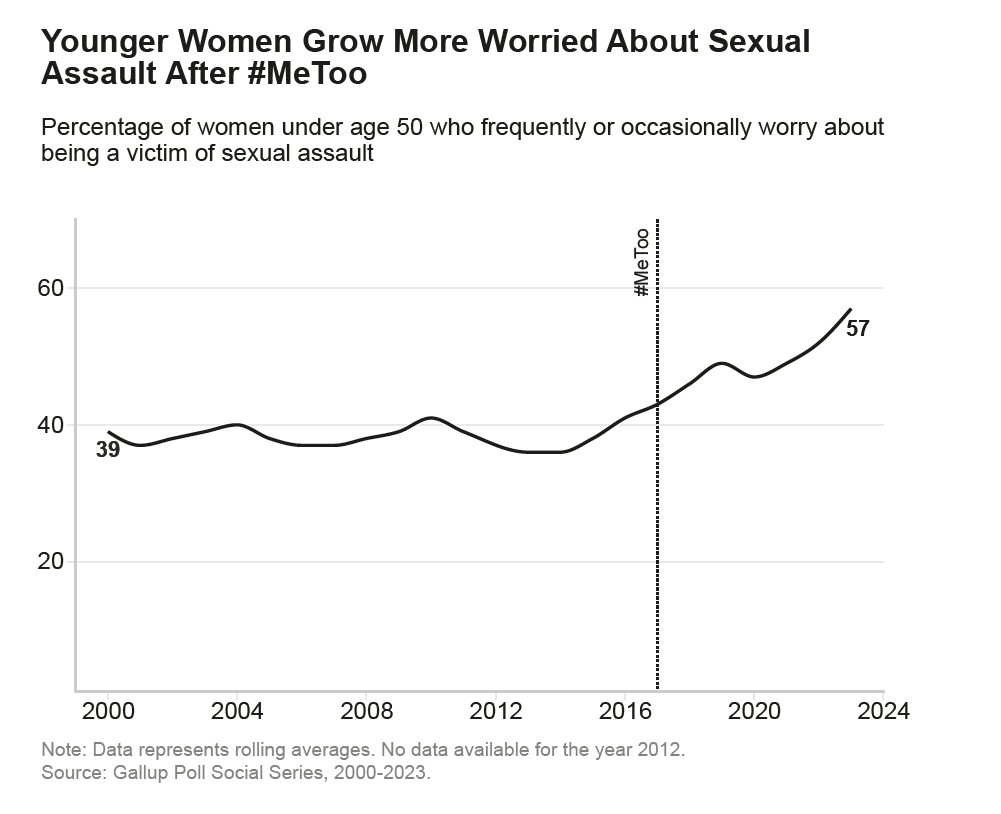
Of the various trends documented in Generation Uncoupled, one of the most startling, dispiriting, and consequential is the rising fear that women feel about their personal safety. For more than two decades, Gallup has tracked public perceptions about crime—the personal sense of threat people feel about being a victim of theft, assault, or even murder. Beginning around 2015, younger women’s fears about being a victim of sexual assault increased rapidly after decades of relatively little change. By 2023, nearly six in ten younger women worried about this at least occasionally.
These feelings surfaced frequently in focus groups, even when the discussion was focused on another topic. I had multiple conversations with women who expressed fears about sexual assault and harassment they either already experienced or were worried might befall them. For instance, Amanda, a thirty-two-year-old woman, reflected on how this omnipresent fear dictated so much of her everyday routines. “As a young woman today, we don’t feel safe, heard, or understood,” she said. “Simple, mundane acts like getting dressed, exercising, walking home, and ordering food at home or an Uber need to be thoroughly analyzed, dissected, and planned so that we don’t end up in compromising situations.”
So many young women feel unsafe.
The events at Cornell University have reignited a conversation about safety, vulnerability and a culture of disregard for the wellbeing of women. To ask why young women feel less safe may seem obtuse—isn’t it obvious?— but the story is complicated.
Even as incidents of sexual assault and rape receive more public attention—and deservedly so—there is no evidence that these horrific incidents have become more frequent. Many of the most egregious problems persist in the way allegations are handled, yet it seems undeniable that they are treated with more care and consideration than they once were. But so many young people don’t trust the process or the authorities running it. Only about half of young women—and a similar number of young men—report that they have either a great deal or a fair amount of confidence in college administrators to handle allegations of sexual violence on campus.
This feeling is not limited to college administrators either. Young women are uniquely untrusting of the police and religious leaders’ capacity or willingness to respond appropriately to allegations of sexual abuse. Only half of young women have confidence that police will respond responsibly to reports of sexual harassment or abuse and even fewer have confidence that church officials will do the same. For young women, the world feels more dangerous for the simple fact that perpetrators can operate with relative impunity.
Too many young people feel they have been left to fend for themselves to protect themselves from harm and to hold others accountable. In Generation Uncoupled, I document a dramatic increase in the ownership of self-defense devices—nearly four in ten young women report that they carry mace or pepper spray with them. So much of the anxiety about personal safety comes from the way we have privatized responsibility for it. It’s no longer a collective responsibility, but an individual one.
When Americans believe that systems that are meant to uphold standards of decency, ensure fairness, and provide accountability are broken, they respond predictably. They become less trusting, participate in social life less freely and generously, and become more guarded. This is especially true when young people believe institutions are irreparably corrupt or broken, and incapable of reform. When no clear path forward exists, all that remains is to hunker down.
When incidents such as the one that took place at Cornell come to light, it can feel like nothing has changed—we’re watching the same old failures play out. But to deny that progress has been made is to abandon any hope that things can get better. Not inevitably, but through incremental improvements and shared effort. We should not overlook enduring obstacles, but we desperately need a more honest assessment of where we are and what work remains to be done. It is a theme I hit on in the book, where I write:
“On any social problem, an accurate accounting of societal progress is a critical step toward solving it. Acknowledgment instills confidence in our collective ability to correct historic inequalities in our systems and institutions, even if progress occurs unevenly, imperfectly, or more slowly than we might wish.”
We overcome fear not individually, not through sheer force of will, but collectively through a belief that we are not alone in wanting things to be better than they are.
Generation Uncoupled Update!
I had an engaging conversation with Jessica Grose at the New York Times about the topic of “attention infidelity,” and the potential damage it can cause our romantic relationships. You can read about it in her excellent newsletter. Here’s a preview:
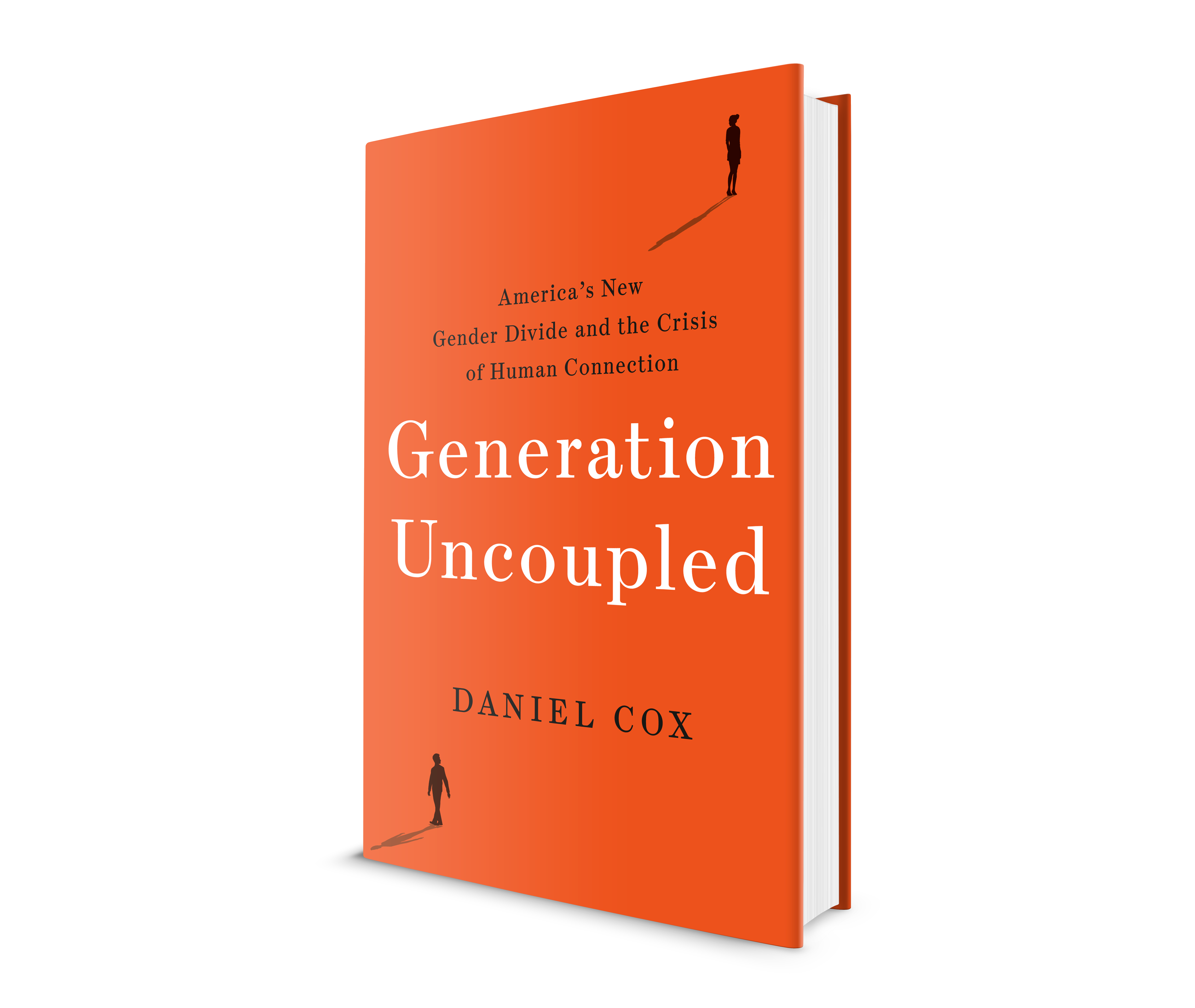
“Mine is not a new fear, and I realize it is born out of a kind of nostalgia. From the pollster and public opinion researcher Daniel Cox’s forthcoming book, ‘Generation Uncoupled: America’s New Gender Divide and the Crisis of Human Connection,’ I learned a new term: ‘attention infidelity.’ Cox defines it in a somewhat unusual and expansive way: when a partner’s digital life intrudes on an in-person connection.
This kind of ‘infidelity’ can include looking at sexually explicit material or engaging in suggestive social media interactions, but more often it is just the banal distraction of dead-eyed scrolling. ‘Instead of reaching for each other,’ Cox explains, ‘we snatch up our digital devices that flood us with an endless stream of hyper-curated content.’”
Yes Cornell brought it to our attention again. But. The election of a serial rapist to potus makes it clear, abusers matter more