

Happy Thanksgiving! If you need something to listen to as you burn off some Thanksgiving calories, check out my conversation with Scott Galloway!
And if you live in New York City, come join me at the Village Underground at 6pm on Dec. 2 for a conversation with Gabriella Kearns of Braver Angels. It’s free, you can reserve your spot here.
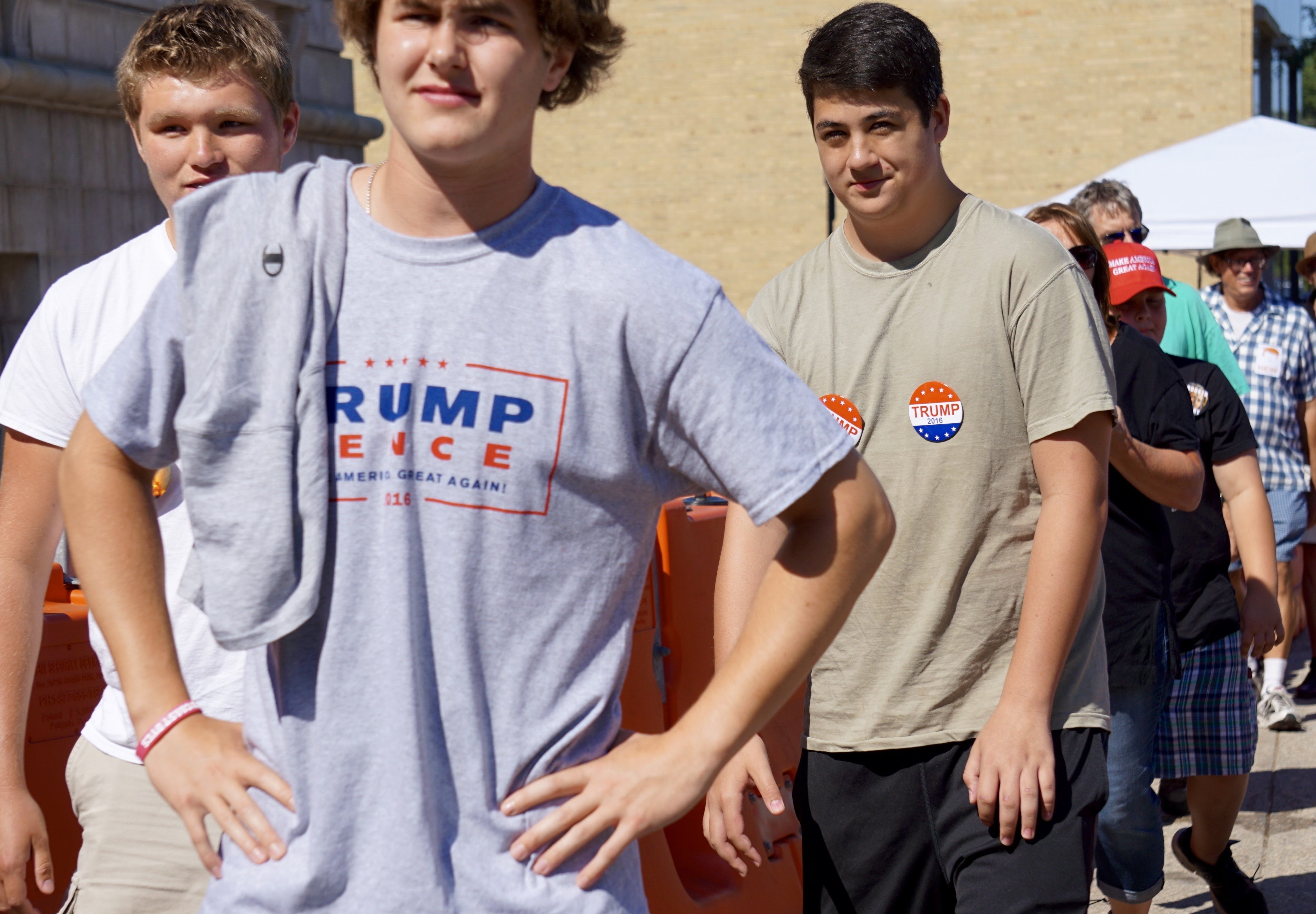
What is the first thing you think of when you read “conservative young men”? Whatever image or thought emerged is probably based on a comment you saw online, perhaps a personal exchange you had, or a news story you read. A lot has been written in the past few years on young male MAGA supporters, such as this provocative piece in New York Magazine, “The Cruel Kids Table,” a largely impressionistic portrait of young conservatives that the writer met at Trump inauguration parties in 2025.
Most journalists strive for objectivity and accuracy in their political coverage, but none of us are immune to being enticed by a provocative comment, a compelling anecdote, or controversial persona. Even in the best instances, when stories are balanced by some empirical evidence, we are overly reliant on anecdotes and personal stories. They loom large in our psyche. A lack of reliable data makes us more susceptible to engaging in generalization and stereotypes. If we read stories that offer compelling narratives but don’t back them up with credible data, we might overgeneralize and mistake an isolated anecdote for an overarching trend.
A new survey offers another way to understand the more complex political preferences and the distinctive worldview of smaller groups of voters. The NORC Civic Health & Elections Project is based on more than 110,000 interviews with registered voters conducted shortly before the 2026 election.1 The sheer size of this survey permits analysis of political subgroups that are effectively invisible in your standard national study.
I’m taking advantage of this opportunity to share some illuminating findings about the state of young conservative men. They both challenge and confirm much of the narrative that appears in mainstream news coverage.
Despite popular representations in the media, most young conservative men are not white. Only 39 percent of young conservative men (ages 18 to 24) are white. And what percentage of conservative men age 65 or older are white? Ninety-one percent. They are more religious than young liberal men, but much less so than older conservatives. About one in five are religiously unaffiliated.
Young conservative men are also less committed to the Republican Party and more critical of Donald Trump, at least in 2026. Only 43 percent of young conservative men identify as MAGA compared to two-thirds (67 percent) of conservative men age 50 or older. Only slightly more than half of young conservative men (53 percent) have a positive view of Trump’s job performance, far lower than among conservative men age 50 older (76 percent).
What about key policy questions? Young conservative men are more likely to support at least some access to legal abortion—in fact, roughly four in ten express this view. At the same time, they are overrepresented among the most hardened opponents to abortion. One in four believe that abortion should be illegal in all circumstances, a rate higher than older conservative men.
On immigration, this group is hardly hardline. Sixty-one percent of conservative young men say refugees facing violence in their own countries should be able to immigrate to the U.S., a view shared by only 39 percent of conservative men age 50 or older. Younger conservative men also care less about this issue. In 2026, older conservative men said the immigration issue was important to their vote, but the same was not true for young conservative men. Only 35 percent of young conservative men said immigration was one of the most important issues facing the country.
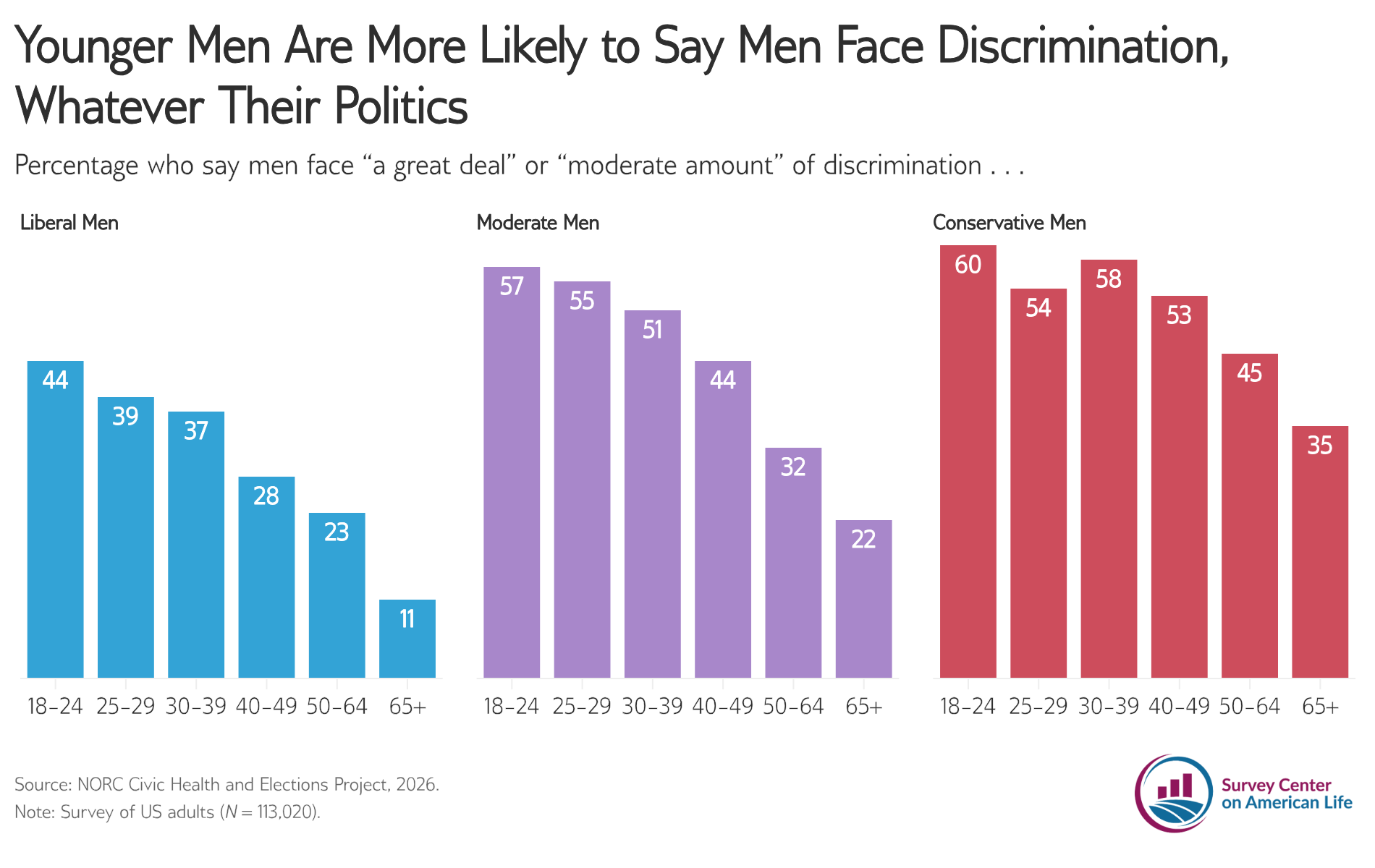
Across the board, younger conservative men believe that historically disadvantaged groups face discrimination. They are more likely than older conservative men to say various groups experience discrimination in American society—women, black people, gay and lesbian people. But when it comes to perceptions of discrimination there is no larger generation gap than when it comes to whether men face discrimination. Sixty percent of young conservative men believe men experience a “moderate amount” or “a great deal” of discrimination in American society. Notably, the generation gap is even larger among both moderate and liberal men.
In 2007, when I was at the Pew Research Center, I worked on a project about American Muslims. It was an extraordinarily challenging undertaking, requiring a complex sampling design and interviews conducted in six different languages. Despite the cost and difficulty, it was an incredibly rewarding assignment. Up to that point, so much coverage of American Muslims had been based on anecdotal reports and media interviews at Mosques or other public spaces. The final report, American Muslims: Middle Class and Mostly Mainstream, helped challenge enduring stereotypes against this religious minority and hopefully reduced some prejudice in the process. The goal is to challenge lazy and self-serving narratives and make room for greater nuance in how we view each other, which creates openings for understanding and engagement. Let me know if you’re interested in a version of this analysis for liberal young women!
1 The sample was based on registered voters representing approximately three-quarters of eligible adults living in the United States. To the extent that the politics of conservative nonvoters differs, they will not be represented here. However, nonvoters are more likely to eschew ideological labels or to identify as moderate and politically independent.

They want a lack of consequences.