

Generation Uncoupled College Tour!
Technically, it kicked off last week, but I wanted to share the lineup of colleges and universities I’ll be visiting over the next few months. There are probably a couple more that will be added to the list. For a complete updated list of speaking engagements, you can go here.
University of Texas – November, 5
University of Virginia – November 12
Dartmouth College – January 12, 2027
Boston College – January 28, 2027
Brigham Young University – February 3, 2027
University of Chicago – February 9, 2027
Yale University – February 17, 2027
Not all of these events are open to the public, but a few of them will be. If any of you have suggestions of local independent bookstores, I’d be happy to consider adding an additional book event if I can fit it in. I’ll also be in New York City the first week of December for two separate events that are open to the public. If you’re in New York City, come out and join. It would be great to meet Storylines subscribers.
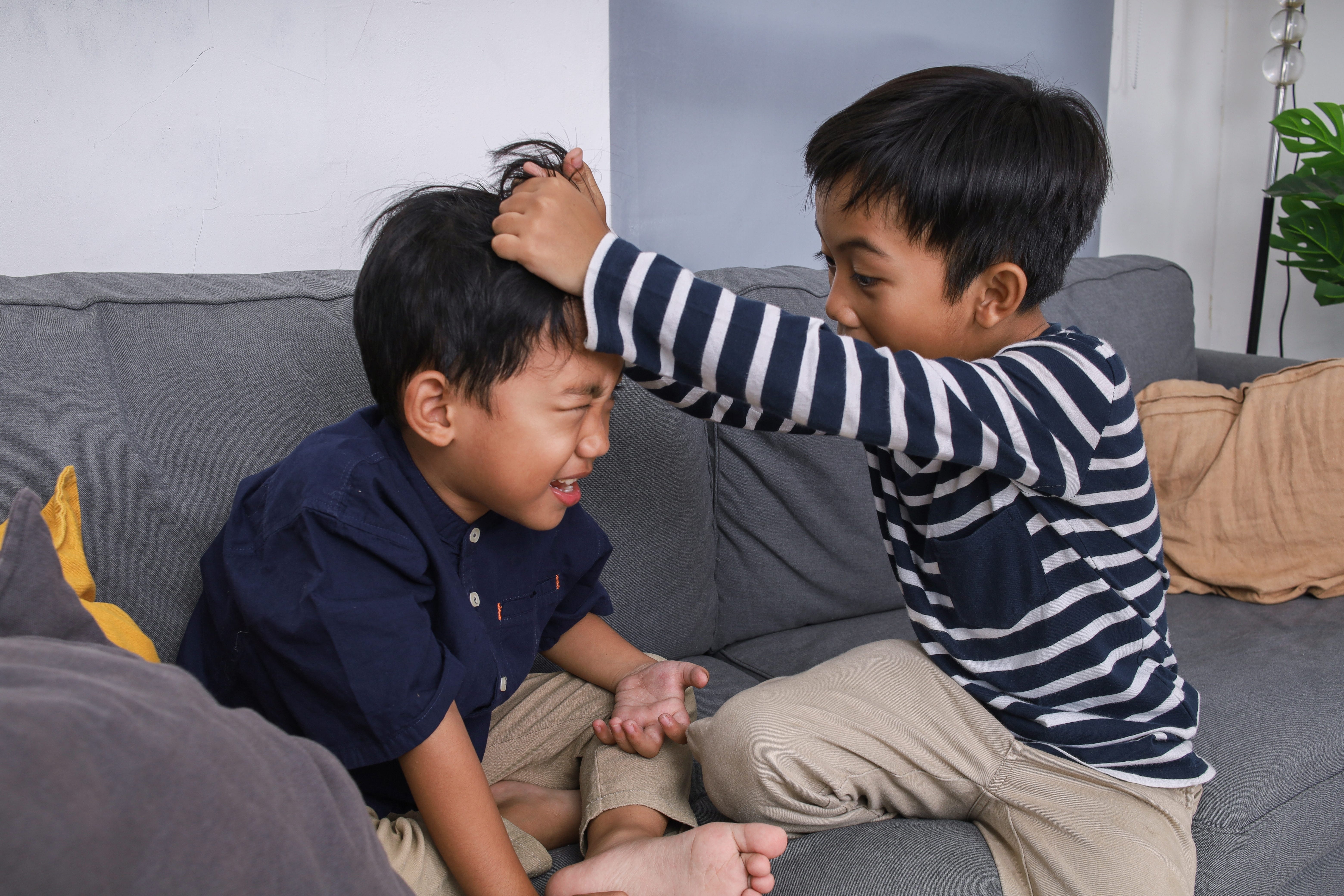
Growing up as a middle child, I was rarely at a loss for a companion, critic, or adversary. My two brothers were roughly two years older and younger, and they defined my social life during much of my childhood. They served as opponents in board games, allies against unjust parental decrees, and competition for food—when pizza was delivered, you had to take all your slices immediately because there was no going back for seconds. We played and we fought. One game of Risk became so heated that we broke a chair—with my older brother still in it.
But we also negotiated, accommodated, and compromised. I shared a room with my younger brother for a number of years. On trips to Blockbuster (RIP), we were permitted to rent a single movie, which meant coming to an agreement because we only had one screen at home to watch it on. In my house now, there are four of us, and we have more screens than people. No one needs to compromise.
Today, family dynamics are quite different. In married households, couples are starting families later, having fewer children, and spacing them further apart. This has led to the decline of formative friction, something I wrote about in Generation Uncoupled:
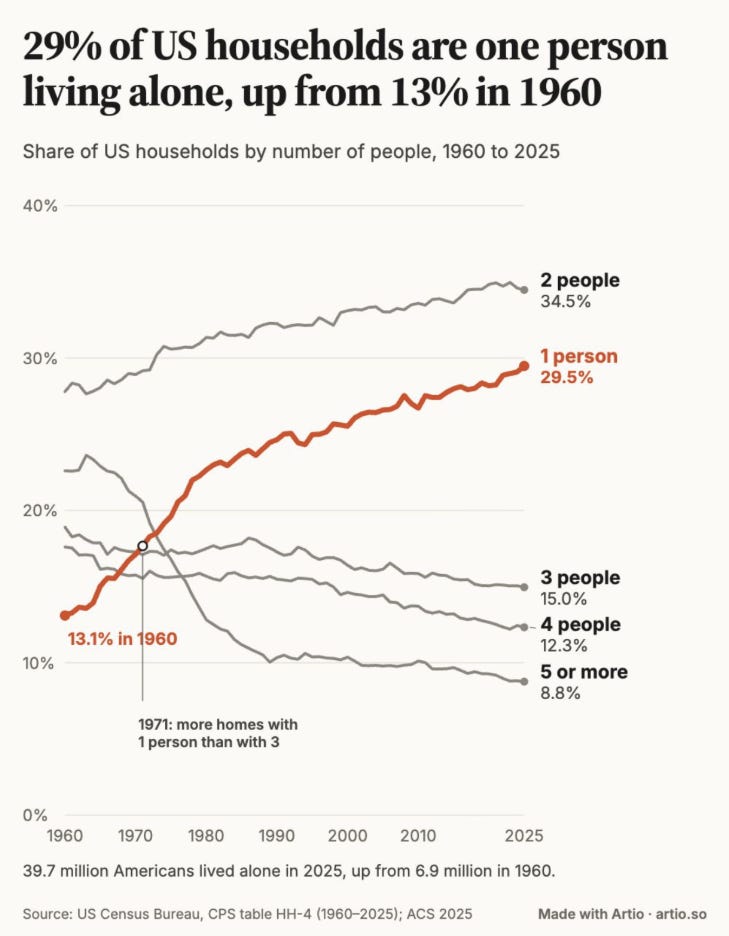
“Americans are living in much larger homes than they once did, but with fewer occupants. The U.S. Census Bureau report found that the median size of a newly constructed single-family home was nearly twenty-three hundred square feet in 2022, representing a 20 percent size increase over homes built in 1990. And the average American household has 2.5 people in it, down from 3.7 people in 1940. Large families are rapidly disappearing. The percentage of women in their early forties who have given birth to only one child has doubled over the past forty years.”
There’s been a remarkable demographic shift in the size and composition of American households. Fewer of us were raised in crowded homes and more of us are living alone.
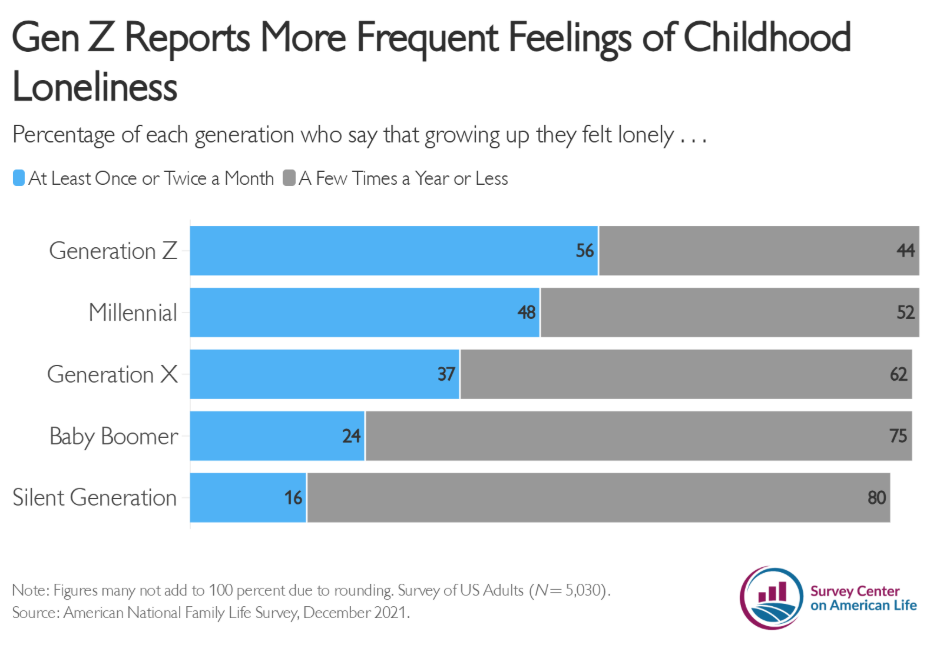
Research has long shown that siblings have a considerable impact on our social and emotional development, but one of the most obvious ways their presence might influence childhood experiences is reducing feelings of loneliness. Surveys that have measured adolescent loneliness show remarkable generational differences. In one survey we conducted, most Gen Z adults (56 percent) reported feeling lonely at least once or twice a month when they were growing up. Less than half as many Baby Boomers (24 percent) said they felt lonely growing up. This same study found that only children expressed more acute feelings of loneliness and isolation than those growing up with siblings. I have wondered at times whether pandemic-induced isolation might not have been so damaging to young adults if they had more companions living under the same roof.
Early experiences influence our preferences later in life. Many U.S. colleges have seen a rapid rise in students requesting single rooms. It’s increasingly a priority. One study, reported by Insider HigherEd found that “at a majority of institutions (51 percent), students rank single rooms as their top choice on the housing application.” As adults, more young people would prefer to live alone to avoid the hassle of group living.
There’s another piece to this that I didn’t address explicitly in the book. In smaller families, there’s a much lower likelihood of having a sibling of the opposite sex. Growing up with two brothers, I thought girls were a mystery. I wasn’t alone feeling this way. There is still an evident gap in empathy and understanding between girls and boys. In the introduction to Generation Uncoupled, I wrote about the need to rekindle curiosity. It was inspired by a thought experiment that I included in a national survey of American teenagers. In the survey, teen respondents were asked to imagine waking up as a member of the opposite sex, and to write about the experience. So many teens in the survey struggled with this assignment. Many of the responses were reductive, dismissive, and overly reliant on generalizations and stereotypes.
Although the young women and men at times expressed different concerns, they shared a pronounced sense of risk aversion, both socially and romantically. Fear of rejection was common, but so was being creepy or cringe. Today, the most powerful technologies facilitate social avoidance. We have apps that encourage us to circumvent actual conversation. We type rather than talk. On messaging apps, conversations are stilted and faceless—starting suddenly and ending abruptly. It is undeniably convenient and gives us a sense of security and control, but we have lost our social rhythm in the process. At my book event at the University of Texas, a young man told me that he disliked talking to people. I was somewhat taken aback as we were engaged in a conversation at that moment. He said it matter-of-factly without a hint of embarrassment or regret. We conducted one study in which 55 percent of Gen Zers reported feeling relieved when their social plans were cancelled.
We’re about to embark on a new project that explores the way Americans use AI in their personal lives. A growing number of Americans are using AI companions as a substitute for human interactions. Although the project is in the very early stages, one theme has already emerged: the draw of companion AI has a lot to do with people wanting to avoid social judgment. AI users feel that they can share their thoughts easily and freely with an AI companion without worrying about what others might think of them. The responses are predictably supportive and affirming. It is a “social” interaction without the possibility of friction. In conversations with AI, there is never a risk of awkwardness, embarrassment, or offense. Because it isn’t human.
In the age of smartphones, I’m sympathetic to concerns about being judged or criticized. Today’s teenagers have to contend with the possibility that any embarrassing moment, or awkward comment can be instantly documented and broadcast to millions of strangers. But social interactions are generally more positive than we think they will be. As I note in the book:
“Researchers at the University of Chicago found that when commuters on a train were instructed to intentionally engage a stranger in conversation, they found the ride more enjoyable than those who did not. This is precisely the opposite of what participants expected their experience to be. The title of the paper: “Mistakenly Seeking Solitude.”
The real risk is that the more time and energy we spend carefully arranging our individual lives, the harder it is to make room for someone else.